Business Hacks
|
Jan 1, 2026
Building a Village Overnight: 12 Lessons from Scaling a Festival
In a year co-directing evolve festival near Berlin, revenues grew 5x and attendance more than doubled — and the process reshaped how festivals should be built and scaled. This article shares the vulnerable behind-the-scenes journey and 12 hard-won lessons for turning a festival from a beautiful idea into a sustainable, scalable platform.
I was sitting across from some of Los Angeles’ most iconic festival producers on an unusually warm September morning. They were planning to launch a 25,000-person sober and transformative festival in August 2026, a bold vision in a city that already hosts some of the biggest cultural experiments on the planet. My role was to help them with executive strategy. And yet, as the conversation deepened, I realized this meeting wasn’t about building another big event. It was about understanding why we do it in the first place.
Just a few weeks earlier, I had wrapped up a four-month sprint co-directing evolve festival, tucked away near Berlin’s forests. What started as a fragile experiment became a living organism. We grew revenues 5x year-over-year and more than doubled our attendees to 1,250. But the real growth wasn’t in metrics; it was in me. What began as an operational challenge became a crash course in humility, decision-making, and the psychology of community.
Festival production is a uniquely human paradox. It combines the creativity of art, the precision of business, and the chaos of weather.
You are building a village from scratch with living spaces, marketplaces, power, food, safety, and governance. Everything is temporary, fragile, and yet profoundly alive. There’s no MBA program that prepares you for watching a thousand people dance under a structure you designed, knowing it might collapse, metaphorically or otherwise, at any moment.
And through all of it, you learn that a festival is both a mirror and a teacher. It will expose your blind spots, stretch your leadership, and consume your certainty. For every decision that works, ten won’t. For every moment of magic, there’s one of exhaustion or doubt. But those who survive a season of festival production carry wisdom very few entrepreneurs ever touch, because they’ve built something ephemeral that changes lives, and then disappears.
When I left that meeting in Los Angeles, I didn’t pitch a plan or secure a contract. I advised them to cancel their festival, at least for that season. The team was exhausted, emotionally raw from years of pushing through burnout. What they needed wasn’t another production; they needed integration. The founder paused, took a breath, and agreed. It was the right call, even if it meant walking away with nothing gained but peace of mind.
That moment crystallized a hard truth: temperament and timing matter more than talent or ambition in this industry.
The festival business is an alchemy of art, logistics, psychology, and surrender. You cannot remove the chaos, only dance with it more gracefully.
Over the course of that year, as I helped build and scale evolve, I wrote down the lessons that actually made the difference, not the theories, but the tools and mindsets that helped us survive and grow. These are the 12 core learnings I wish more festival organizers internalized, especially those in their early stages of growth.
The immediate goal of a new festival is not profit
Most new festivals die because they chase profitability too early. In the first years, the economics are structurally against you: fixed costs are high, risk is concentrated, and almost every major decision is made under uncertainty. When organizers obsess over “being in the black” from day one, they tighten every budget line, under-invest in growth, and make decisions from scarcity. That rarely produces a great experience, and it almost never builds a festival strong enough to survive.
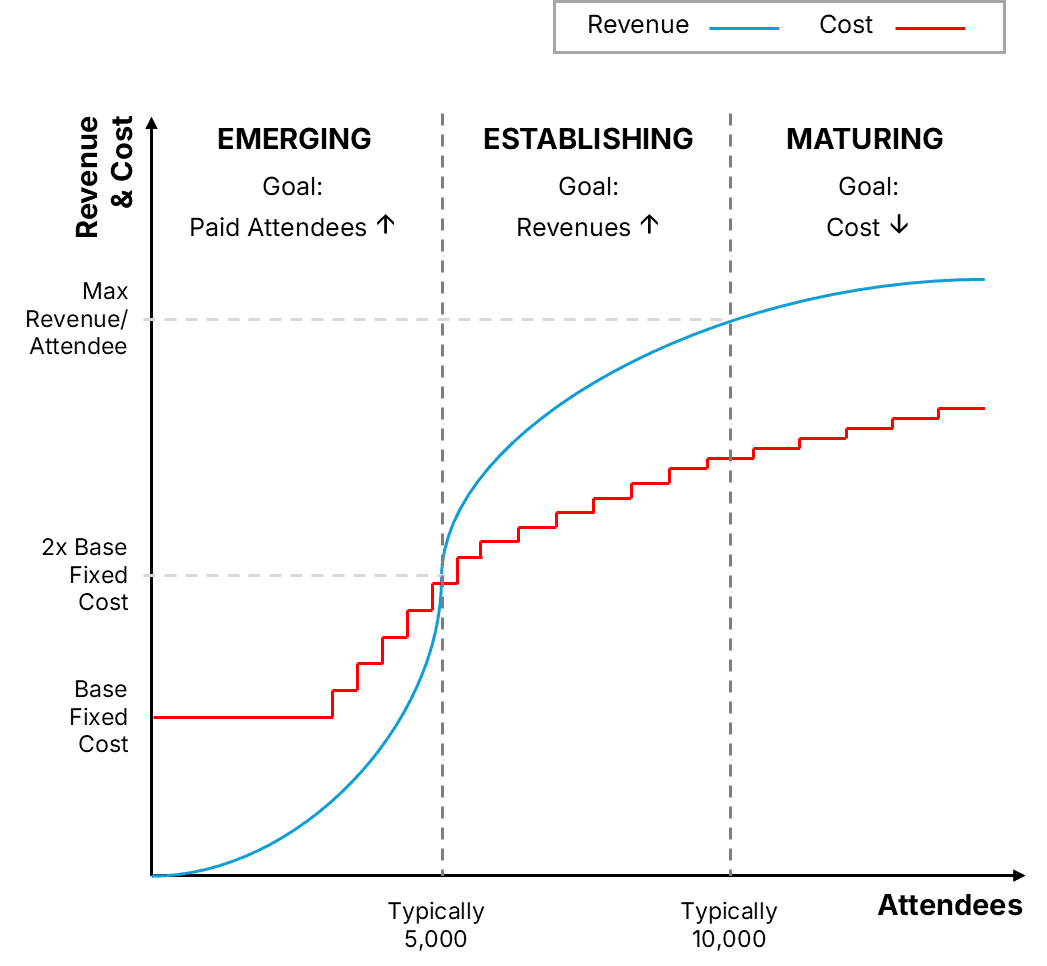
It is more helpful to think of festivals in three phases of growth.
Phase 1 – Emerging: usually under about 5,000 attendees, or more precisely, the stage where ticket revenue has not yet reached at least 2x your base fixed cost — everything you must spend regardless of how many people show up, including realistic salaries or wages for founders and the core team. In this phase, the only rational goal is to grow the number of paid attendees and escape this fragile zone.
Phase 2 – Establishing: roughly around 10,000 attendees, or the point at which your revenue per attendee starts to plateau because pricing and on-site spend have reached a healthy ceiling. Here, the main lever is increasing total revenue: better offers, smarter tiers, stronger upsells, and deeper partnerships.
Phase 3 – Maturing: typically above 10,000 attendees, where adding more people no longer increases profit at the same rate and the real gains come from cost optimization, operational efficiency, and margin improvements.
Understanding fixed costs is critical. Festivals do not scale costs linearly; they grow in steps. As you add stages, infrastructure, and safety measures, base costs jump, especially in the early years, and then rise more slowly later as you standardize and reuse assets. A festival only becomes truly robust when ticket revenue is at least 2x the base fixed cost — that buffer is what absorbs weather risk, marketing underperformance, or a weaker year without bankrupting the project. For many German festivals, that break-out point sits around 5,000 attendees, but the exact number will depend on your ticket price, program complexity, and staffing model.
Seen through this lens, the mandate for a Phase 1 festival becomes simple: stop trying to squeeze out profit and focus on escaping Phase 1 as fast as possible. That means designing the event and the marketing engine to grow paid attendance to the point where your revenue comfortably doubles your base fixed cost, including fair pay for the people running it. In this phase, growth comes mainly from expanding reach — the top of the funnel — not from endlessly optimizing conversion on a tiny pool of leads. Profit is not the goal yet; survival, momentum, and audience growth are. Profit comes later, once the festival has earned the right to think beyond scarcity.
2. The marginal cost of an attendee is invisible, but it is not zero
Most festivals behave as if every extra attendee is “free”, which is why guest lists often explode. In the spreadsheet, nothing seems to change when you add 20 more people. In reality, festivals grow in steps: every 500–1,000 additional attendees usually means more stages, toilets, security, power, waste management, and support staff. That step function hides the true marginal cost. See figure in lesson 1 to understand how fixed costs increase variably in steps.
If you want to stay sane, map those steps explicitly. Define the thresholds (for example: 0–800, 800–1,500, 1,500–2,500), then calculate how much extra you spend when you cross from one band to the next and divide that by the number of attendees in that band. That is closer to your real marginal cost per person. But here is the uncomfortable truth: even if the marginal cost per person were close to zero, giving away guest passes still erodes your brand, trains your community to wait for freebies, and cannibalizes late-tier revenue. Better to disappoint a few friends this year and train them to buy early next year, than to build a culture where your work is always expected at a discount.
3. Earlier is cheaper, later is expensive
Festivals punish hesitation. Decisions about stages, lights, sound, permits, infrastructure, and key hires are almost always cheaper and more flexible when made early. As the date approaches, choices narrow, vendor options shrink, and you start paying panic premiums for everything from toilets to truss. Shorter lead time directly increases unit costs and reduces your negotiating power.
At evolve, the most stressful expenses were rarely the biggest ones on paper; they were the ones decided at the last minute when the team was tired and options were limited. Every time something slipped into the “we’ll decide later” bucket, it came back as a more expensive and more stressful problem. The discipline is simple but not easy: front-load decisions, lock in key infrastructure early, and treat procrastination as a silent budget killer.
A festival looks chaotic from the outside, but most of the chaos that hurts you financially and emotionally is predictable. Problems with access, traffic, check-in, sound bleed, crew confusion, or misaligned expectations rarely appear out of nowhere on opening day; they are usually the end result of rushed planning, untested assumptions, and poor communication. Economic impact studies show that planning horizon and process quality are critical drivers of event outcomes.
The antidote is unglamorous: start a year out, build a clear operating model, and test it. Prototype stages. Run simulations of entry flows. Validate your processes with small pilots. Stress-test vendors before they’re mission-critical. On top of that, resist the temptation to do everything in-house just because it feels cheaper. Unless outsourcing a function costs more than 150% of doing it internally and you have the capacity and competence, buy the service. Every new in-house process increases your cognitive load and creates hidden overhead that will hit you hardest in show week.
4. Do not try to fix everything
Once the gates open, perfection becomes your enemy. A festival is a temporary village with hundreds of interdependent systems, many of which will fail in small ways no matter what you do. If you try to fix every broken sign, late volunteer, minor complaint, or imperfect transition, you will burn out your leadership and drain resources from the problems that actually matter.
The work before the festival is prevention; the work during the festival is triage. Decide early what kind of problems you will simply accept as part of the experience. Design a simple decision filter:
Must fix now (safety, legal, cash flow, core experience)
Can pay to make it go away (throw money, don’t throw your focus)
Can ignore and contain (communicate, but don’t overreact)
The discipline of letting some things stay broken is what keeps your executive attention available for the few things only you can solve.
5. You scale by selling more tickets, not cutting costs
Many festival teams try to “save” the event by going into austerity mode: cutting stages, shrinking teams, negotiating every invoice to the bone. Cost optimization is necessary, but it only moves the needle so far before you hit diminishing returns. Beyond a point, you are just shrinking the experience and amplifying a culture of scarcity, which then bleeds into every decision and every communication with your community.
The real unlock is almost always on the revenue side: selling more tickets at a healthy price, improving your offer, or increasing per-capita spend on-site. That requires courage, clearer storytelling, better marketing, and sometimes a willingness to charge what the experience is actually worth. Cutting costs is clinging to control. Selling more tickets is choosing growth, stepping into uncertainty, and backing the value you are creating.
6. You are not selling a festival, you are selling a story
Unlike a restaurant or a product on a shelf, people buy festival tickets months in advance, before they have any proof of what the experience will be like. Even established festivals reinvent themselves every year — lineups change, locations shift, and the weather never reads the script. In that uncertainty, your audience isn’t buying tents, stages, or lineups. They are buying a story about who they will be when they are there and who they will be when they return.
This is why Fyre Festival, disastrous as it was operationally, managed to sell out purely on narrative and imagery. Most organizers dramatically under-invest in story: the emotional arc, the core promise, the transformation, the language and visuals that capture it. For most of the year, your primary job is not “producing a festival”; it is telling a story so clear and compelling that people rearrange their lives, budgets, and travel to be part of it. The production then becomes your way of honoring that story.
7. Social media is not marketing
Social media is a channel, not a strategy. Posting content to Instagram or TikTok feels like marketing because it is visible and immediate, but until you have serious scale, those channels alone rarely move enough tickets to build a sustainable business. For most emerging festivals, the highest ROI comes from a mix of search (organic and paid), email, partnerships, local communities, affiliates, and physical presence — all orchestrated around a clear funnel and pricing strategy.
Marketing is a numbers game as much as a creativity game. Someone needs to own the acquisition model: cost per lead, conversion rates per channel, pricing tiers, promotions, and lifetime value. The content creators report to this person, not the other way around. Until your social media accounts are truly large, treat them as just one of several pipes feeding your funnel, not the entire system.
8. Until you sell out the festival, focus on reach
Many young festivals copy the tactics of mature brands and obsess over conversion at the bottom of the funnel — retargeting, nurturing hesitant leads, endless early-bird extensions. That only works when your brand is already well known. In the early stages, your biggest problem is not conversion; it is that far too few people even know you exist.
The most important metric in that phase is reach: how many people in your target audience are even aware that your festival is happening. Design campaigns that dramatically expand that number: partnerships, cross-promotions, regional PR, aligned communities, workplace programs, ambassadors. Once awareness is high enough, conversion tactics start to work. Until then, over-optimizing the bottom of the funnel is like polishing a funnel that has no water going into it.
The median decision time window for new buyers is 3 weeks
Buying a festival ticket is not like buying something on Amazon. People are not just weighing price against value; they are also checking time off work, travel, accommodation, other commitments, and who they want to go with. Decisions like this sit somewhere between buying household goods and buying a car or a holiday — emotional, logistical, and rarely instant.
Across many events, a large share of tickets is now bought within the last 30–45 days, but not usually within hours. For new buyers, the median decision window tends to cluster around three weeks from first serious contact to purchase, stretching to around five weeks when the festival still feels far away and compressing to about a week when the event is close. The key is to treat this as a real delay in your funnel design. If you trigger a big reach event — for example, a national yoga chain mentioning your festival in their newsletter — do not place a price jump or expiring offer a few days later. Most of those people simply will not be ready to commit yet. Align your major promotions and tier changes to land roughly three weeks after any big awareness push, so you are catching people at the moment when they are finally ready to decide.
Sell next year’s tickets at 70% off for 48 hours after the festival
At the end of evolve 2024, we did something that felt almost irresponsible on paper: we launched evolve 2025 tickets at 89 EUR for 48 hours, against a late-bird price of 249 EUR. The discount was intentionally absurd. Within two days, 125 people bought those “super early bird” tickets, and more followed at 99 EUR in the weeks after. Some bought with the explicit intention of reselling later — and that was part of the design. Those people became an unpaid, highly motivated sales team. For the next 12 months, they talked about evolve to friends, invited people to join them, and built their holidays around the festival.
Industry guidance often suggests 20–40% discounts for early birds, but our experience showed that a one-time, extreme discount directly after the event can act as rocket fuel for growth if your unit economics allow it. In evolve’s case, we did not just rely on that burst; we rebuilt the marketing engine around reach and partnerships for the following year. By the time evolve 2025 happened, about 1,250 tickets had been sold — roughly 10 times the volume of that first 48 hours and about double 2024’s attendance. We repeated the experiment for evolve 2026 with a 99 EUR super early bird and sold nearly 500 tickets in 48 hours, setting the stage for an event next year that could cross 3,000 attendees and become one of Europe’s largest sober festivals. This is not a forever tactic; once a festival reliably sells out at capacity, the extreme discount can and should be retired. But in the growth phase, a 48-hour, ~70% off “thank you” window right after the festival can lock in cash flow, build social proof, and turn your most excited guests into your most powerful marketers.
11. Don’t manage people, manage outcomes
Festival economics are unforgiving. If your team structure is bloated or overly managerial, you end up spending most of your energy coordinating people instead of delivering outcomes. Layers of “managers of managers” emerge, and suddenly half of your schedule is meetings about meetings, while core tasks slip.
A lean festival team is organized around clear outcomes, not hierarchy. Roles like Volunteer Manager, for example, should function more like HR and logistics — recruiting, scheduling, and placing volunteers with the right team leads — rather than micromanaging daily tasks. Team leads should have clear, measurable outcomes (“X gates open on time”, “Y participants checked in per hour”, “Z complaints resolved within N minutes”) and the authority to get there in their own way. When you manage outcomes and keep communication flowing around those, you preserve both agility and accountability.
12. Your festival is not an event, it is a platform
For many facilitators, artists, and speakers, a festival slot is not just a gig; it is a platform. They get access to hundreds or thousands of aligned participants, professional photos and videos, and association with your brand — all of which compound into future opportunities and higher rates outside your event. But most people negotiate with you as if you were just another one-off show.
Your job is to reframe that conversation. Make it clear that you are building a platform where value flows in multiple directions: they bring their craft and their audience; you offer scale, visibility, and a curated context. This does not mean you ask everyone to work for free. It means you use the platform value as leverage to negotiate fair but sustainable fees and redirect as much budget as possible to the often invisible backbone — the crew and volunteers who make the whole thing work. When people understand the platform logic, they stop seeing your budget as an insult and start seeing it as an invitation to grow together.